Showing posts with label esoterica. Show all posts

Sunday, February 25, 2007

our eyes are not pro-active

I think pretty seriously that this fleshed out comment-cum-blogpost at Nonprophet art deserves a bit more attention. Here's what Geoffrey said:

What just popped in my head was the day i finally understood that our eyes aren't proactive. Our vision doesn't move out like tentacles and actually gather information. Instead we eat what little we are given through a slot under the door (again with the crack in the wall) as our eyes process light that enters them. and we learn that the different combinations of light is a this or a that. And we separate those this' and thats' and put them in a logical order, as bohm says, intitially, so that we can deal with them easier. Until our logic becomes so smug that it believes it can take it from here, and begins to tell our eyes what is and what is not. Our expericence becomes based on what we now think we see which forms our perceptions which eventually... yes... allows us to see only what we want to see. (and you can rearrange all that in whatever order you wish.)

Ok. Is that just too difficult for the CAA to comprehend? That smugness has become the raison d'etre of the whole art making machine, and it is based completely on the inability to see. Noticing the edge of your model's arm, and how that contrasts with whatever happens to be behind it, is not like first year drawing class stuff.

When I suffered the realization that Geoffrey describes above, I realized also that when one understands the glint on an eyeball, and that one has been missing that and a thousand other contrasts and pure, simple, characteristics, then one is facing the very means by which people are imprisoned in language games and meaningless gestures and lives. It is cleverness at language that allows us to bypass nuance and resonance. It is our clever reading of history's failures that allows us to make the same mistakes without appreciating that the splash of blood on stones sounds exactly the same now as it always did.

Just as capitalism is understood to be the answer to everyone's prayers, despite its disastrous effects on mankind, we are continually told that the problem of light falling on a naked body was solved a long time ago. In fact, it is just as problematic as ever and even more so a problem than private arms producers controlling the US government. We could (and should) imprison all of them, but we still can't see the naked body. Can't you just see those tenured MFA department chairs just insisting that they can see eeeeeeeeeeeeverything?

We can pretend all we want that what we are doing is seeing, gazing, gaping, oggling, leering, but we are left, of course, at the limit of understanding the moment we realize that we have chosen to see mostly the pussy and the boobs, those things to which we are particularly blind. That's why art people call it "reading," thus suggesting some common public will "read" the work. And of course that is precisely why we, those of us not looking for the television read on life, seldom tire of looking. And what simply makes it such a severe problem is that we know we have the capability of seeing, and yet we leave this faculty to be described by morons, Patrick Nagels with machine guns.

The point I think Geoffrey's post leads nicely to is that people, artists, whoever, who can see, who understand the limits of seeing, are less apt to be tearing other people apart. You can tear arguments apart. But it is much more difficult to tear apart someone who has discovered that light creeping around a branch or an arm is not the same as light coming out of a television. The light cascading from from a branch in the forest might finally be seen. The object of desire might be experienced, even indirectly, at last through someone else's eyes if not through our own. That's why I find it so easy to work with artists who understand this even when I can barely stand them personally. We get drunk and fight later about some stupid language issue, but we spend all day anticipating that one precious glimpse and providing them to one another.

This seems to me to lend a moral imperative to good painting.

Sunday, February 11, 2007

on motivation and the resonance of things

every post should have a picture I left out of that last post, (though you might have picked it up in the comments) that the question I was responding to was along the lines of "How do you keep yourself motivated?"

It's a good question and it leaves out, or maybe relieves, the preachy tone that the post might otherwise carry. Maybe the issue is less being motivated than in having some reason, accepting it and understanding it. I can't imagine myself doing any kind of art on the social science model, artist as social observer, critic and commentator. So boring and so consistently wrong. Yet it's not a walk in the park trying to figure out that the part of you that ends up listening to you talking to yourself all day is smarter than the part of you doing the talking. (No, not you, Steven.)

The social implications of an art based in un-mediated people and what they think and how we act and talk and communicate and look is far more staggering than an art based on the false mystification of science. Science, including social science, is very good at rooting out mysticism. My writing and blogging and art making tries to do the same. In a way. Yet there is some un-mediated (un-mediated by language) activity that we experience and try to hold onto. Usually we do it by means of language. But I think we also do it by remembering, and some of that remembering we do through means other than will. That is to say, somethings just insist that we remember them even if we don't know why. I am haunted still by the same things that scared me as a child. Only now it is teeth-gritting fun to get chills, to leer into the abysses where things are still spooky. And fortunately plenty of the people who got good at looking into such things and remembering them throughout history also had a finger or two dipped in the mysticism bowl.

When I see art going on in New York and people talking about it, or the shows coming up this summer, I think about those people in line outside the Today Show. Part of growing into your art is realizing that you're really not ever going to face the audience of wankers they warned you about (and prepared you for) in grad school. Audiences are smart, they're not like the Today Show anymore than the Today show is like reality. Art professionals are catching up with us slowly, but they have cell phones to compare and they are not in any hurry. Being motivated is almost like being desparate. I desperately do not want to talk to art professionals when there are good people being alienated by shitty art. But I also desperately want to understand why when two things come together they mean more than thing A + thing B. In the sum of their two parts is a resonance the appreciation of which is the key to more than you might think.

Thursday, August 17, 2006

content/discontent

Not a lot of time to write today, but seriously, this post from Springs and Wells is the most important thing I've stumbled across in the blogosphere since I don't know when. Though I like the nice stuff that Seeker after Truth puts up from K-murti and others, I think S&W did just as well:

my understanding of contentment is a state in which one could accept things as they truly are - and work with that.

Thursday, July 27, 2006

quoting bateson

Whoever creates an image of an object does so in depth, using various cues for that creation[...] But most people are not aware that they do this, and as you become aware that you are doing it, you become in a curious way much closer to the world around you. The word "objective" becomes, of course, quite quietly obsolete; and at the same time the word "subjective," which normally confines "you" within your skin, disappears as well. It is, I think, the debunking of the objective that is the important change. The world is no longer "out there" in quite the same way that it used to seem to be.

Without being fully conscious or thinking about it all the time, I still know all the time that my images—especially the visual, but also auditory, gustatory, pain, and fatigue—I know the images are "mine" and that I am responsible for these images in a quite peculiar way. It is as if they are all in some degree hallucinated, as indeed they partly are. The shower of impulses coming in over the optic nerve surely contains no picture. The picture is to be developed, to be created, by the intertwining of all these neural messages. And the brain that can do this must be pretty smart. It's my brain. But everybody's brain-any mammalian brain—can do it, I guess.

I have the use of the information that that which I see, the images, or that which I feel as pain, the prick of a pin, or the ache of a tired muscle—for these, too, are images created in their respective modes—that all this is neither objective truth nor is it all hallucination. There is a combining or marriage between an objectivity that is passive to the outside world and a creative subjectivity, neither pure solipsism nor its opposite.

Consider for a moment the phrase, the opposite of solipsism. In solipsism, you are ultimately isolated and alone, isolated by the premise "I make it all up." But at the other extreme, the opposite of solipsism, you would cease to exist, becoming nothing but a metaphoric feather blown by the winds of external "reality." (But in that region there are no metaphors!) Somewhere between these two is a region where you are partly blown by the winds of reality and partly an artist creating a composite out of the inner and outer events.

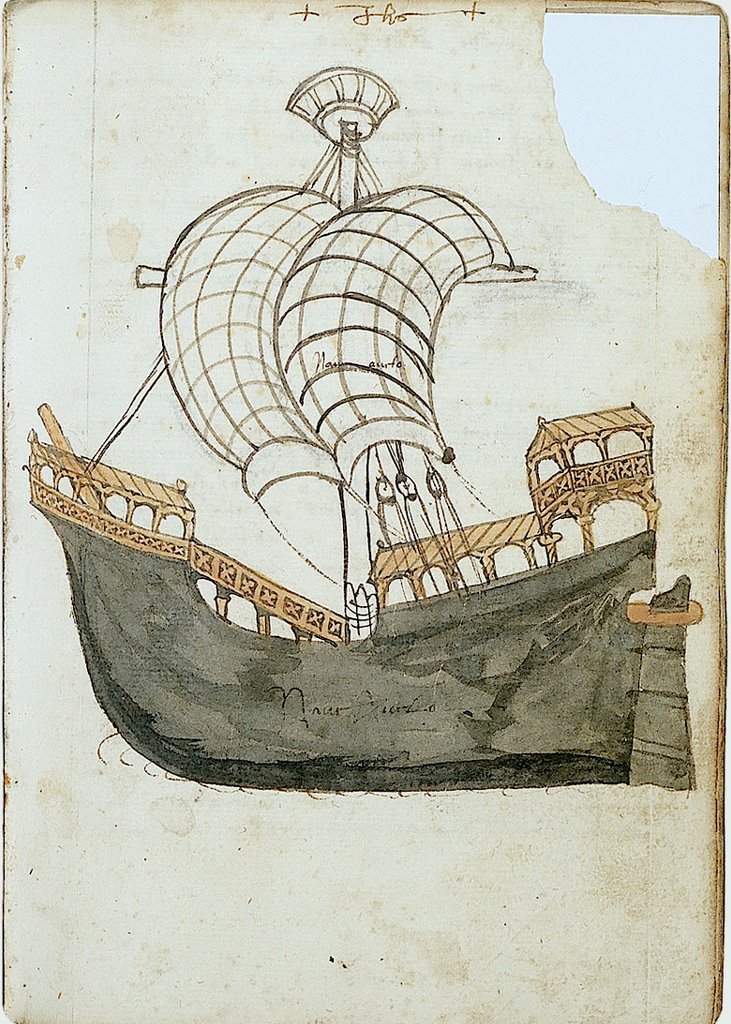
Quoted from www.edge.org. Image from the Michael of Rhodes manuscript via Bibliodyssey.