Showing posts with label art scene. Show all posts

Thursday, November 06, 2008

Party Monster


These days, when asked at dinner parties in New York what kind of paintings I do, I hesitate knowing that somehow God will slip into the conversation and I will never be asked back.

- Marshall Arisman interviewed by Vickie Karp at Huffington.


There's a scene in Party Monster where the venerable James St. James is asked just who were the Club Kids. He nostaligically remembers the period in Manhattan in the aftermath of the death of Andy Warhol when a vacuum opened up in the NYC nightlife and the kids all swarmed in to fill it.

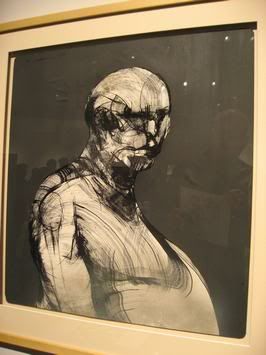
It's a vacuum we're still contending with. Perhaps I am not paraphrasing the scene exactly accurately. I won't be watching the movie again. But maybe the "publicity for publicity's sake" attitude is on it's last legs. The Marshall Arisman illustration is yanked with thanks and gratitude from DetroitArts.

Thursday, March 15, 2007

what artist can't do....


this is my list of things, so far, that serious artists can NOT do.

Please feel free to add to it in the comments so that it can grow and prosper like poison ivy.

1. Artists can not look at the art-work at an opening reception. Openings are for conducting business, networking, clowning (if it's SERIOUS clowning).

2. Talk in any way that is personal, about your personal problems or your personality (unless it is fictional) or in a way that might lead others to believe that you are human and not a "business machine." Artist should try to remember that they are always conducting a public relations campaign, that should be designed to promote the work, not any old vision of humanity or something communist like that.

3. Artists must not operate in any way that might lead one to believe that they seek in any way to actually threaten the understandings of art that our great leaders from Brown and Yale and CIT and similar esteemed programs have deemed TRUE.

4. Amongst all that truth is the "relativism of truth" which we must accept as true and not question. Therefore, an artist can have opinions but a serious artist must only express such opinions if s/he is in the company of lesser artists and in such a setting where the expression of said opinion will serve the purpose of furthering the Public Relations aims of the same serious artist. All other opinions are valid, but vapid, unless published.

5. Painting can be undertaken but only after memorizing the entirety of the October Magazine pantheon, pretending to both dismiss it entirely and understand it totally. Any attempts at feeling the subject of the painting will only be discussed with fattish art-girls.

6. Feeling anything is un-acceptable, unless part of a performance about numb-ness.

Wednesday, February 28, 2007

on the exhalted guru and why he still so tortures us

Everyone I know is still haunted by this character from art-school.

Those of us who have experimented with mysticism and mystical apparatus and all those chanting, breathing-exercise goings-on find him (yeah, usually it's a guy) terrifically annoying. Particularly as the Exhalted Guru's chief experience today is usually made with reference to market factors, dealers (they're just down to earth people, man) and those creepy gallery people, you know, the buzz-cut women in their fifties and the art-clown in his alterna-costume.

I've written some pretty mushy things here, things that make the institutional artists cry. Like about Ancestory and Subconscious stuff... and trying to be honest, making art for personal reasons first.

But I hope I've made it clear that even real, mind-blowing enlightenment kind of stuff is really pretty low-brow for artists. Dude, we've been there, and it was like, WOW, ok, not going to save anyone with that heightened consciousness, now matter how high, broad or deep. That's low-brow mysticism. Admittedly, it's not as bad as the market-based stuff, but still...

The idea comes from this modernist thing, the fringe character on the edges of society, who has been to the top of the mountain, and heard god talking there. Not freaking Derrida, not some mamby-pamby who went to Brown and got a degree in talking to herself. Was talking to GOD man! It's a bit older than the 20th century really.

OK, so let's say for a second you accept that artists have been interested more or less in mysticism for like the last 7 or 8 thousand years. Before that everyone was living pretty much in the Mystical Soup, right ? Well, sadly, no, that is wrong. That 7 or 8 thousand years marker is good for the actual start of Mysticism but it happens to coincide nicely with the invention of agriculture, food surpluses (and thus POWER), and yes, sedentary living.

So my fellow nomads, I am sorry if I have lost you with this ramble. The next time someone tries to impress you by taking on the "I been to the top of the mountain" schtick or the "I talk this way cause it makes me seem like I know something" schtick, just say "dude, we are moooooving on, would love to stay and chat, but we really gotta eat tomorrow."

Sunday, February 25, 2007

our eyes are not pro-active

I think pretty seriously that this fleshed out comment-cum-blogpost at Nonprophet art deserves a bit more attention. Here's what Geoffrey said:

What just popped in my head was the day i finally understood that our eyes aren't proactive. Our vision doesn't move out like tentacles and actually gather information. Instead we eat what little we are given through a slot under the door (again with the crack in the wall) as our eyes process light that enters them. and we learn that the different combinations of light is a this or a that. And we separate those this' and thats' and put them in a logical order, as bohm says, intitially, so that we can deal with them easier. Until our logic becomes so smug that it believes it can take it from here, and begins to tell our eyes what is and what is not. Our expericence becomes based on what we now think we see which forms our perceptions which eventually... yes... allows us to see only what we want to see. (and you can rearrange all that in whatever order you wish.)

Ok. Is that just too difficult for the CAA to comprehend? That smugness has become the raison d'etre of the whole art making machine, and it is based completely on the inability to see. Noticing the edge of your model's arm, and how that contrasts with whatever happens to be behind it, is not like first year drawing class stuff.

When I suffered the realization that Geoffrey describes above, I realized also that when one understands the glint on an eyeball, and that one has been missing that and a thousand other contrasts and pure, simple, characteristics, then one is facing the very means by which people are imprisoned in language games and meaningless gestures and lives. It is cleverness at language that allows us to bypass nuance and resonance. It is our clever reading of history's failures that allows us to make the same mistakes without appreciating that the splash of blood on stones sounds exactly the same now as it always did.

Just as capitalism is understood to be the answer to everyone's prayers, despite its disastrous effects on mankind, we are continually told that the problem of light falling on a naked body was solved a long time ago. In fact, it is just as problematic as ever and even more so a problem than private arms producers controlling the US government. We could (and should) imprison all of them, but we still can't see the naked body. Can't you just see those tenured MFA department chairs just insisting that they can see eeeeeeeeeeeeverything?

We can pretend all we want that what we are doing is seeing, gazing, gaping, oggling, leering, but we are left, of course, at the limit of understanding the moment we realize that we have chosen to see mostly the pussy and the boobs, those things to which we are particularly blind. That's why art people call it "reading," thus suggesting some common public will "read" the work. And of course that is precisely why we, those of us not looking for the television read on life, seldom tire of looking. And what simply makes it such a severe problem is that we know we have the capability of seeing, and yet we leave this faculty to be described by morons, Patrick Nagels with machine guns.

The point I think Geoffrey's post leads nicely to is that people, artists, whoever, who can see, who understand the limits of seeing, are less apt to be tearing other people apart. You can tear arguments apart. But it is much more difficult to tear apart someone who has discovered that light creeping around a branch or an arm is not the same as light coming out of a television. The light cascading from from a branch in the forest might finally be seen. The object of desire might be experienced, even indirectly, at last through someone else's eyes if not through our own. That's why I find it so easy to work with artists who understand this even when I can barely stand them personally. We get drunk and fight later about some stupid language issue, but we spend all day anticipating that one precious glimpse and providing them to one another.

This seems to me to lend a moral imperative to good painting.

Thursday, February 22, 2007

there are two sides...

In case I've not been clear enough in all of my rantings.

There are those who think that the New York and Euro-centric views of art criticism, curation and education just need improving, and a bit more understanding. Clarity, and then the understanding will get better.

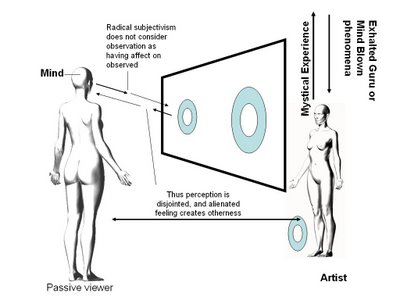
And there are people like me, who look at the accompanying illustration and wonder what is the difference between these guys and the art-scene as we know it.

Wednesday, February 21, 2007

realization and psychology

Therapy is the bugaboo that just drives art professionals and others wild. "WHAT'S THE DIFFERENCE BETWEEN YOUR ART AND THERAPY?" they are always screaming.

That's because the art people we are stuck with, and the ones we are always trying to leave behind are stuck with this gross 2oth century view of "psychology" as this thing that lives, for good or bad, in our heads.

When I write about realization, realizing, understanding and growing into being the person that you are supposed to be, I write with the assumption that all of us come from an environment that is less than ideal for our own realization. That is to say, we come from a psychology that is less than ideal. But I don't particularly believe in a psychology that needs an acute focussed attention such as was conceived in the last century. Psychology today is an environment that artists inhabit and that artists are uniquely positioned to affect and improve upon.

That is why, to me, Venice seems like spam. How is it possible to improve on that environment (that psychology)? Is that not the point of art ? ok assume for a moment that it is not... In such a case one can approach Venice with the old psychology and try to enjoy the external environment of Venice with one's own psychology sealed faithfully up inside one's head as always. Then of course one is free to enjoy all the messages zinging in and out of Venice as if they were unsolicited emails from which you can pick and choose. "I like the African pavilion about starvation, but I say thumbs down to the Swedes' Techno Installation."

I mean really. It's a bit boring. Whenever I go to Venice I like to learn about Venice for the Museum it is, and that it can hardly improve upon. Then I think of this Biennale thing as sort of a bulk message folder and I say "Yes, I am sure I would like to delete all of it, thanks," and I go back to pondering what combination of sun and sand and salt can make the sea such a brilliant color. Doubtless there will be more than one artist there who could impress me, but they would well do the same thing in a cafe in Arkansas, where the environment and the psychology is doubtless in more need of attention.

Realization is the realization of environments, especially the ignored ones and the invisible ones. Those to me are the ones that need not messages and one-liners, but awareness and honesty. The ability to see Trieste or Venice is not questioned. Yet every city has an invisible sector. In fact, Venice should be famous for invisibility, mirages and blind alleys. Instead it seems to me it is famous now for pointed, focussed messages that we intentionally delete. Hope everyone's Carnevale was fun.

is the Venice Biennale spam ?

I am taking a lot of heat from some near sources for referring, in a comment over at ArtBlog Comments, to the Venice Biennale as Spam.

Let me make one thing clear. I write my blog for other artists, and I use that definition in a broad sense so that anyone with an interest in creativity or the creative process is included. I've been to the Venice Biennale a few times and every time I wonder why such a wonderful city would mar itself with such a gross display of dehumanizing amateurish shreck. I have no doubt that I could get plenty of Viagra pills in the Armory, that the value is terrific, even if they are shipped in from Canada but that is not what I would go there for.

Your credit history truly doesn't matter if your stolling the Giardini and happen upon the juxtopositions of modern culture with social commentary that truly causes you to want to re-think that second mortgage. The Corderie is a wonderful place to meet local guys and gals, all of them with pictures. I don't have any doubt that you could in fact meet them. It is not that spam is not true. What makes it annoying is that we don't care and we don't want it. We go to the Venice Biennale, just like we open Newsweek Magazine, and instead of information that changes us and opens us, we get events like this (from Wikipedia):

At the 51st Biennale, American artist Barbara Kruger was awarded with the "Golden Lion" award for life time achievement.

HA HA HA HA. Golden Lion! Achievement! God! You can't make this stuff up. Now, that isn't to say that there is no good content in Newsweek magazine. It's just that it has nothing to do with me. Newsweek and Venice assume that I have erectile dysfunction, and if I keep reading Newsweek or strolling the Giardini of Venice, well, I'll probably get it.

Sunday, December 24, 2006

egoism - altruism

Mexico City street scenei thought i would take a stab at answering Gusky's very thoughtfully posted question:

Some have replied that ego is the drive to make one's mark in the world. I suppose that's another side of ego, the side related more to a will to power and self-assertion.

The questions that this drive raises are, "What kind of mark, and where, and why?"

I'd think that the artist whose need to leave a mark on the world is the dominant drive should be asking him/herself the more basic question of why it's the dominant drive. What inner need does this drive to leave marks in the world satisfy?
Conveniently, another post cropped up, Alain's really fascinating presentation/ discussion at Long Sunday of the David Graeber article in Harper's which I've not read. Now I can't blame Gusky for leaving out the Altruism side of things, as I'd never thought of it either. I would probably approach ego from the sort of clinical perspective of western psychology myself. Graeber's approach, seems to suggest that both Ego and Altruism arise simultaneously as a product of market economy. To clip Alain's quote of Graeber:
In the ancient world, for example, it is generally in the times and places that one sees the emergence of money and markets that one also sees the rise of world religions - Buddhism, Christianity, and Islam. If one sets aside a space and says, "Here you shall think only about acquiring material things for yourself," then it is hardly surprising that before long someone else will set aside a countervailing space and declare, in effect: "Yes, but here we must contemplate the fact that the self, and material things, are ultimately unimportant." It was these latter institutions, of course, that first developed our modern notions of charity.
Pretty fascinating really. At least I thought so. Graeber goes on to critique the role of these two factors, egoism and altruism, in a discussion of left versus right politics arguing that the right has established a monopoly on both ego and altruism, Value and Values. And for this, Alain's discussion is quite good, the left will flail helplessly forever unless it can take hold of one. Frighteningly, I have to clip from Alain's quoting of Graeber once more:
why do working-class kids join the army anyway? Because, like any teenager, they want to escape the world of tedious work and meaningless consumerism, to live a life of adventure and camaraderie in which they believe they are doing something genuinely noble. They join the army because they want to be like you.
Of course, we have heard this argument raised before... (someone leave a comment telling me where was that bit about working class kids becoming artists because it is higher status than they could otherwise achieve,) and I don't believe it is anything but on the mark. As Gusky wants to know, what inner drive does this mark-making want to satisfy? Is it just, again, escaping tedium and consumerism? I fear often enough it is. Here of course I could predictably go off on my usual rant about higher education, elitist institutions and the right-wing. (Please, close Yale already.) But I will spare you.

I think I am probably on the same page as Gusky, in wanting more art and less ego, more art where the artist is transparent. Where an artist is conducting the fluid motion of meaning through elements and into the waiting ~mind~ of the recipient, and where the recipient is understood broadly to include the artist and the environment also. All of us are participants in that environment, and we understand art to be a kind of play that we do to increase our understanding of ourselves in our environment. It isn't altruism after all. I suspect Gusky will agree.

Doing what we do is just more work and that work, like any work, fails when it serves the ego. Take a look at Donald Trump or Michael Jackson, two pathetic IQ-around-50 imbeciles whose attempts to successfully conquer their own miserly egos has resulted mostly in continued and spectacular failure. Do I need to mention the so-called leader of the free-world ?

In reflecting on Gusky's original question, I think it helps to point out that the ego is a construct successfully engineered for the western mind and one which has out-shown the utility of western economic thinking. We've created a world in which genius cannot lead because the entire apparatus of communication is arrayed against that shining historical ego. What we have now is the marketed personality judged only by its sale-ability and hence the goons of the New York gallery scene, hence the goons of MSNBC, hence the GOP. Ego-less art will be decidedly emasculated and profoundly personal, almost limp to those still carrying egos. But don't confuse its veracity by judging it with the Western Ego. It will have no borders and it won't carry well in glossy magazines.

It will probably sell. Just not enough to impress.
Friday, December 22, 2006

second letter to an art friend

robotsDude - the other night i was stuck with a bunch of the most milque-toast miniature art stars that Mexico has to offer, all of them spoke perfect English and had one foot in some kind of success... success meaning they get to act like people who go to parties with Paris Hilton, or success meaning now they can afford flat screen televisions, or success meaning that although their lives are still plagued by the same problems as everyone else, they get to project those problems onto the larger world in the form of their disjointed, disfunctional and frankly ugly art. There is plenty of ugly art to go around. And it comes from ugly people trying to further distance them selves from all of the ugliness in the world so they can be above it, or so that they don't have to be losers, while the rest of the world, especially the losers are just that--losers.

Art is one thing in the whole world that nobody ever has to be a loser at and in which nothing is competitive. It is like trying to regulate healthcare in a market economy. It has nothing to do with competing to be better or to succeed. Market economies fail, and they fail spectacularly when they try to apply their stupid "rules" to non-economic spheres of life, like health and art.

The reason I am saying this to you is that I can see you have a far greater understanding of the role and capability of art than many people at your level. I ask you to trust that and though it is probably a load of shit, you just might come out on top after some time struggling. Don't look at it as emotional distance, just as emotional acceptance. You need those things, you need emotional involvement, you just don't need judgement. You don't need to regret having emotions, but you need to see that the emotions are real and useful, and that ultimately they are yours to use. Emotions are not your master, but you are theirs.

I remember I used to sneer at what my instructors told me: to try to paint with "feeling," as if I had no choice, and so I spent most of my time trying to paint without it. But now, when I look at all my struggle to escape or conquer "feeling" it seems most of what I did was judge what I should or should not feel, and that act makes mountains out of our most basic and natural responses to the situations that confront us. Of course you felt bad and resentful and worse. You did and you will again. And in the course of those many emotions over a lifetime, one ends up seeing that they were the richest part, or that they allowed us inroads into parts of thinking and understanding that otherwise are just part of ourselves that we take for granted as silent and unreachable.

Our dialogue is with nature, and with forces that will destroy us if we don't keep talking. I can understand artforum magazine, but I can't understand what a line in the dirt means. I have to try. Some rocks. Some branches. I was walking under a palm tree in a mediocre rain when some great branch came crashing down, literally spiraling like a snake. And I can't say that it was an epic event like something that happened to Antigone. Yet in jumping and laughing at myself for my startled outburst, I couldn't help but think in the black recesses of those sun-baked palm leaves, and the twisting curl of that terrible branch, there wasn't just as much tragedy as one could wish for. I put the tragedy into the branch and compare it to a snake. But there is always a bit more, an excess of meaning. You put your problems on paper, and I see not only paper and problems, but you and nature, and that should make us think of great waves crashing. Like a rhythm of understanding always, in its approach and subsequent recession, hoping we will grasp that it is not aggression and passivity, but a balanced understanding of both. We have to be like nature, both aware and completely unaffected, not unaffected emotionally, but without judgement. Sounds so eastern, but somethings always do.

Monday, August 14, 2006

"almost everything was explained"

As I’m painting lately, I’ve been listening to an audio-book recording of Mikhail Bulgakov’s The Master and Margarita. It occurs to me that certainly, had Bulgakov not been persecuted, censored and maligned in the Soviet Union, he almost certainly would have been awarded the same honor in the West. The Master and Margarita is so utterly subversive as to shock even my rather un-shockable eyes.

I can't help but think this strange writing must have somehow found its way into the thinking of the great Latin American writers who followed. In many cases, the influence would be seemingly as impossible to deny as would the influence of say Gorky or Gogol on Bulgakov himself. But at one point I was wondering if I could deduce some rules or tips toward understanding contemporary art in light of this art, written as it was, in the first acerbic foam of modernism's failure, a failure that many seem yet to have grasped. For as the Soviet experiment failed, it seems clear to some of us, the American has now also.

Part of that failure surely has been in Kuspit described in the quote I pulled a few days ago. Neo-conceptualism, according to Kuspit, "strips art of unconscious import, reducing it to institutional site specificity and social objectivity, indeed, into a token case of an ideological or theoretical position." Bulgakov had written a screed of unconcious import, at once surreal, outwardly critical and creatively dynamic.

I can almost hear, if not actually feel, the snear that Joanne Drucker would greet something like Fisher's Complicit My Piehole post. Like the official art that Bulgakov parodies to the point of transcendence, Drucker's exhibition and very thesis is a neo-conceptual capitulation against life and against art in favor of an official "token case of an idelogical or theoretical position." Part of that token theoretical position must be that one can make "meta-art" without first and or at least simultaneously making art. This is really what Bulgakov got me to thinking. His is certainly an art within art, fiction within fiction about fiction, and poetry and creativity. Manuscripts do not burn, but official theorem is like flashpowder. Neo-conceptualism is the Socialist Realism of right now.

I'm not going to spell out much more on the antagonistic warfare being fought between pop-culture capitulators and high art defenders. The masses know perfectly well what is the difference. I think that Bulgakov would be not at all surprised to see so many official artists towing the line that official art has to do with official dichotomies, token ideologies, token theories. The not-so surprising thing about the conservativism of "neo-conceptualism" is its reliance on experts with no, or very little experience of art portraying themselves, almost religiously, as experts in "Art."
___________________
Image is from the Russian Bulgakov site here. A nice list of available online works is here.

Thursday, August 03, 2006

art and entertainent, 2

Ever notice how bent people get when you challenge their taste for meaningless, drivelly kinds of mass-pop culture. I'm not talking about comic books or good rock bands, but that sort of committee-written, J-Lo kind of mass culture. The answers are always that it's just for fun. "It's shallow, but I think enough as it is." In my experience a lot of them get really defensive, too. It is like their weakness for garbage culture is covering up something, some void that they have to protect. I am not writing this to attack garbage culture. I would prefer to think of it as trying to get at the bottom of the right-wing brain (not that there is much besides bottom in that culture-less wasteland.)

We can accept maybe that real culture comes from individuals. The good example I think is the comparison between the Mattress Factory and the New Museum. Mattress Factory is a one woman show, with a fierce director and an endless string of fantastic shows, all of them flavored by what she thinks and wants. New Museum is a committee driven sort of museum store that endlessly promotes irrelevent installations and issues press releases. There are worse examples than the New Museum, but New Museum is of comparable size and scope to what it could be, namely, something like the Mattress Factory.

But if you get in there and start prodding at what the New Museum is supposed to be and what it is you get statements like this:

The Media Lounge is New York City's first museum program dedicated to the exhibition and exploration of digital art, experimental video and sound works. Media Lounge exhibitions and public programs are supported by the Rockefeller Brothers Fund, the Jerome Foundation and the New York State Council on the Arts.

Just that word "lounge" should tell you that this is an appeal to the savvy entertainment driven youth set. It's frankly insulting to anybody who is interested in culture outside of the lounge scene. But I'd be willing to bet that there is a huge crowd who would argue vigorously that this is just the sort of entertainment the modern museum needs to present in order to reach the lazy, spectacle oriented segment of the market that pays the bills. Maybe Rockefeller and Jerome should cough up a little more so that this kind of crap isn't necessary. And that way New York's premier contemporary art museum could concentrate on putting together good exhibitions of real art instead of entertaining doo-dads that spin and whistle like Jennifer Lopez.

I think a big part of the culture-entertainment complex is dedicated to re-inforcing the notion of a stupid public, to building that public and feeding it like school kids with sugary coca-colas. And those kids damn-well want their sodas !! Just watch out when you tell them that water is not only good for them, but it's used to wash people's feet and float baskets and has meaning. There's nothing like coming between someone gorging on distraction and the source of their pain.

Tuesday, August 01, 2006

art-world vs life-world


One of the things I always remember and always forget is that the art-world is us and the creepy freaks in the galleries and the museums work for us. Not the other way around. I have been reading a lot of art blogs about society this and society that, art-world this, art-world that. Really, we choose who to listen to. It is a little difficult to remember when the democracy we grew up with and expected to help us turned against us and bit us all on the ass. But that is hardly a reason to turn over and die.

I've also been thinking a little about this argument of art-like versus life-like art, and wonder, with respect to all the commited abstract artists, how the conversation they're holding can really move anywhere. It seems to me that most abstract art is now working more in the area of appropriation and can't really go much beyond that. Not that there is anything wrong with Sherry Levine. This goes in for my Wittgensteinian argument that art is part of language and new modes of expression using existing vocabularies is more interesting to me than inventing new vocabularies that speak mostly about existing understandings. Anyway, I don't see any limit to inviting new people into this dialogue. And I think Diletante Ventures did a bang up job, at least for my side.

art and entertainment

Thanks to ArtSlob. This piece on Vincent Price is really quite excellent and links to better and better stuff.

My involvement with East Los Angeles is because it couldn’t happen there. It’s much too honest a neighborhood. It is completely isolated from this world over here. It’s completely different. I was invited to come and talk to this college, which was about five quonset huts on a mudflat, by a woman named Judith Miller. And she wanted me to talk about the aesthetic responsibility of the citizen. That’s a pretty classy title. Well, it fascinated me since the aesthetic responsibility of three quonset huts on a mudflat was not very high. But I went, and I fell in love with it, fell in love with the whole Latino community—Chicano, whatever they call it now. But this was where I decided to put my energy, and to do it without any way identifying myself with it. Because I was accused here of using the arts as an entrĂ©e to a world that I didn’t want to be in anyway. People sort of said, “He’s an art snob,” and I just didn’t want to be an. . . . It’s very difficult for me to talk about it. But that’s why forty-five years ago I started this collection in East Los Angeles. It’s been used, it’s grown, it’s produced some very exciting artists.